SASE vs VPN: Which Is Better for Securing Multi-Location Retail and Franchise Networks?
May 2, 2025
Understanding Secure Access Service Edge (SASE)
Definition and Overview of SASE
Ever heard someone drop the term “sassy” in tech talk? No, it’s not what you might think. Here, SASE stands for Secure Access Service Edge, a fancy name for a network approach that mixes your regular internet moves with some top-notch security muscle. Think of it like giving your data a VIP pass wherever it roams, whether that’s on-site, remote, or cloud-bound. SASE merges bunches of network and security services into one cloud-based gig, keeping things slick and secure.
What’s in the SASE toolkit? Well, you’ve got a lineup that sounds straight out of a spy novel: Software-Defined Wide Area Networking (SD-WAN), Secure Web Gateway (SWG), Cloud Access Security Broker (CASB), Firewall as a Service (FWaaS), and Zero Trust Network Access (ZTNA). Together, they make sure that whether you’re posting cat videos from home or running a business across several continents, your connection’s tighter than a jam-packed rock concert.
Curious to break open the SASE treasure chest? Peek at our guide on what is sase for the full deets.
Key Components of SASE Architecture
Here’s the lowdown on SASE’s toolkit, all engineered to serve up synchronized networking and security straight from the cloud’s pantry:
| SASE Component | What It Does |
|---|---|
| SD-WAN | Makes your apps feel like butter on toast—smooth and less prone to glitches. |
| SWG | Stands guard like a digital bouncer, checking your online moves against a list of no-nos. |
| CASB | Acts like a hall monitor for cloud traffic, ensuring your info behaves and plays by the rules. |
| FWaaS | Think of it as having a Rottweiler in your router—staving off intruders and sniffing out threats, all while chilling on a cloud. |
| ZTNA | Go ahead, be picky. It’s only letting familiar faces through the door, scrutinizing each login like a hawk. |
Each of these plays a part in creating a super strong but flexible network that’s perfect for businesses, especially if you’re working from some far-out places.
Still want more? Check out our insights on how SASE stacks up with our articles on sase network architecture and sase implementation.
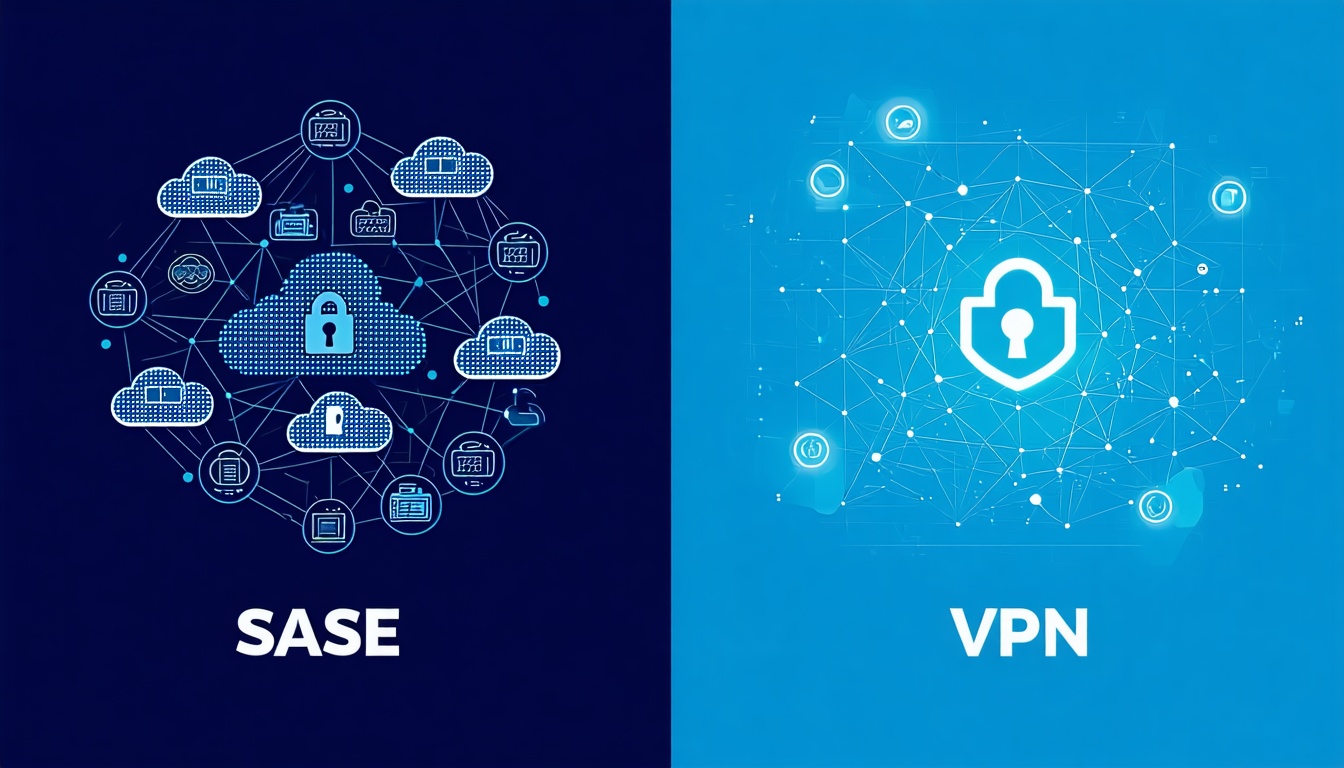
For a face-off between SASE and old-school setups like VPNs, see how they measure up in our comparison guide at sase vs vpn.
When all these pieces come together, you get a solution that’s perfect for handling today’s networking hurdles and keeping things buttoned up while making life a bit simpler. Want to see how it all meshes with real-world actions? Swing by our sase use cases for some good examples.
Virtual Private Network (VPN)
Explanation of VPN Technology
Imagine a secret passageway just for your data, keeping it safe from prying eyes on the wild, wild web. That’s what a Virtual Private Network (VPN) does. It sets up a shielded line on an open network like the Internet. Employees working away from the mothership—that would be their main office—use VPNs to scuttle securely into company territory. This tech wizardry encrypts information zooming between a user’s gadget and the company’s network, locking it away from nosy parkers.
Top Features of VPN:
- Encryption Magic: Think of it like putting your info in a super-secret box only you can open.
- Gatekeeper Check: Before you get in, you need to show who you are, like a bouncer at a club.
- Tunneling Tricks: These nifty protocols wrap your data in an invisibility cloak, sending it safely on its merry way.
Pros and Cons of VPN for Multi-Location Retail and Franchise Networks
Using VPNs to keep multi-location stores and franchises bolted tight has its upsides and downsides.
Pros of VPN
- Amped-up Security:
- Your info stays snug as a bug in a rug.
- Shields juicy business details from digital baddies.
- Reach Out from Afar:
- Workers can get to the company’s treasure trove from anywhere.
- Makes it easier for folks to work from wherever life’s taken ’em.
- Wallet-Friendly:
- No new fancy gear needed; just work with what’s already there.
- Room to Grow:
- VPNs stretch with you as your team grows without breaking a sweat.
Cons of VPN
- Speed Bumps:
- Encryption adds some lag to the internet race.
- Slow connections might test your patience.
- Maintenance Headaches:
- Keeping everything shipshape takes ongoing effort.
- Tech teams might find themselves in the weeds fixing hiccups.
- Flying Blind Spots:
- Sloppy setup leaves room for digital interlopers.
- Insiders with itchy fingers could muck things up.
- App Security Gaps:
- While your data is armored, apps and devices could still be vulnerable.
| Feature | VPN |
|---|---|
| Encryption Magic: | Yes |
| Remote Wonder: | Yes |
| Cost Level: | Middle-of-the-road |
| Performance Dent: | Possible slow poke |
| Management Puzzle: | Tricky |
IT pros in forward-thinking firms need to size up VPN perks and bummers. Other snazzy options—like SASE—could cover more ground sturdily. Comparing SASE and VPN shows you which tech suits your scattered empire best.
SASE for Multi-Location Retail and Franchise Networks
Why SASE is a Game-Changer for Secure Networking
SASE is like a superhero for your multi-location retail and franchise networks, seamlessly blending security and network services into a single, cloud-based wonder. Think of it as your network’s all-in-one security guard, combining tools like secure web gateways, firewall services, and zero trust network access. It’s ready to deliver top-notch protection and smooth sailing access to your essential resources, no matter where you are.
Key Benefits:
- Better Security: SASE pulls all the important security tools into one basket, which makes it a breeze to keep a tight grip on security policies no matter where they’re deployed.
- Grows with You: If your retail business or franchise has dreams of growing bigger, SASE is your friend. It expands with ease, no need to buy more gear.
- Easy Management: With a one-stop shop management tool, your IT crew can watch over and control all network activities so your security measures stay consistent across the board.
- Smooth Performance: Cloud power helps SASE cut down the waiting time and boost network performance, making it run like a well-oiled machine.
- Pocket-Friendly: By doing away with the need for multiple security services, SASE keeps those pesky costs in check.
| Benefit | What It Means |
|---|---|
| Better Security | All security tools in one place |
| Grows with You | Scales with your business |
| Easy Management | Simple control panel |
| Smooth Performance | Faster network with cloud support |
| Pocket-Friendly | Lower costs overall |
Curious about adding SASE to your setup? Check our article on sase use cases.
How SASE Tackles Retail and Franchise Network Hurdles
VPNs are old news and sometimes just a pain for businesses with many locations. Enter SASE, ready to tackle these issues head-on with style:
1. Safe Remote Work: As working remotely grows ever popular, SASE ensures employees everywhere are linked safely to company resources. Unlike clunky old VPNs, SASE offers rock-solid security at the edge of your network.
2. Less Complexity: SASE is all about simplicity, wrapping network and security features into one neat package. No more juggling different tools and services; it makes network management downright manageable.
3. Staying in the Clear: For stores and franchises handling customer data, staying compliant is a must. SASE delivers the right tools to make regulatory compliance easier to achieve.
4. Grows on Demand: Cloud-based goodness means SASE can flexibly grow to match your business’s ever-changing needs, so your network can handle whatever comes its way.
5. Speed Matters: Using a vast network of global touchpoints, SASE slashes delays and pumps up user satisfaction, critical for any retailer working to keep customers happy.
| Challenge | SASE Fix |
|---|---|
| Safe Remote Work | Strong security right where it’s needed |
| Less Complexity | All-in-one functionality |
| Staying in the Clear | Easy compliance tools |
| Grows on Demand | Handles fluctuating demand effortlessly |
| Speed Matters | Faster connection through global support |
Saying goodbye to old-school VPNs, SASE clearly stands out. For a closer look, see our guide on sase network architecture.
Deploying SASE can change the game for retail and franchise networks with boosted security, better performance, and effortless scalability. Get more insights into SASE with our take on sase cyber security.
Comparing SASE and VPN
Jumping into the security game, choosing between Secure Access Service Edge (SASE) and Virtual Private Network (VPN) for protecting multi-location retail and franchise networks can be a bit like picking the right tool out of a packed toolbox. So, buckle up as we break down how they stack up in performance, security, and costs.
Performance and Scalability
Performance-wise, these networks need to run like a well-oiled machine, managing ups and downs in traffic like a professional DJ tweaking the decks at a rave.
| Aspect | SASE | VPN |
|---|---|---|
| Performance | Turbocharged thanks to smart computing and nifty traffic shortcuts | Slows down due to crowded traffic jams |
| Scalability | Sky-high potential with cloud tech | Struggles, needing more gear to handle more juice |
SASE is like the hotshot racer, swerving past traffic with smart computing and shortcuts that keep it zooming even when things get busy. VPNs, meanwhile, can feel like getting stuck behind an ancient van on a one-lane road, hampered by a congested and centralized approach.
Security and Compliance
For networks that handle sensitive info, security isn’t just a feature—it’s mission critical, like having a sturdy umbrella in English weather.
| Aspect | SASE | VPN |
|---|---|---|
| Security Measures | Top-tier with all the bells and whistles like Zero Trust and fancy threat protection | Basic locks and keys—encryption and logins are your lot |
| Compliance | Comes equipped with the full compliance toolkit | Needs extra kit to stay compliant |
SASE rolls out the red carpet with features like Zero Trust, beefy threat protection, and top-notch encryption, while VPNs offer more basic security, like a modest apartment lock in a posh neighborhood. Plus, when it comes to compliance, SASE makes life easy, with everything you need built right in, unlike VPNs that need extra bits and bobs.
Cost and Management Features
Keeping costs in check while making it easy to manage isn’t just a pipe dream—it’s what keeps the IT folks sane and the budget happy.
| Aspect | SASE | VPN |
|---|---|---|
| Cost | Pay-as-you-go fun, less cash tied up in the long run | Can burn a hole with hardware and tinkering costs |
| Management | One-stop cloud shop for all your controls | It’s all over the place, with admin points scattered about |
SASE shines bright with a subscription model that’s easy on the wallet, thanks to its minimal need for physical stuff. VPNs can hit the pocket hard with gear and upkeep. And when it comes to management, SASE is the friendly neighborhood cloud solution, while VPNs can leave you juggling admin points, feeling like a cat herder in a suit.
For more on how SASE could be the hero your multi-site operations need, why not have a peek at our articles on what is sase, sase network architecture, and sase implementation.